
Well, I began this on Sunday. Does that count? And it’s more than four because I’m long overdue on this.
- Developing your intuition.
- Can Xerox’s PARC, a Silicon Valley Icon, Find new life with SRI?
- The concept of using only what you have.
- The Predictive Brain.
- Table Top Experiments.
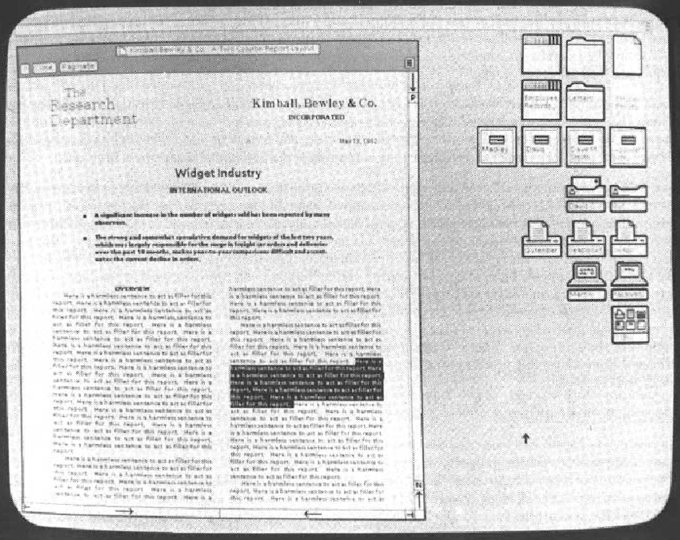
Cover image: Fig. 3.9 Xerox Star, 1981 from: https://mprove.de/visionreality/text/3.1.6_xeroxstar.html
——
Developing your intuition.
I was watching a lecture late one night, which I think is some kind of somnambulant addiction of mine, when something Physicist and Oceanographer Professor Allan Adams said woke me up.
“The goal is to learn quantum mechanics, [by that he means] to learn some intuition. Develop some intuition for quantum phenomena (quantum mechanics is not hard!) It does require concerted effort. It is not a trivial topic. In order to really develop a good intuition, the essential thing is to solve problems. The way you develop a new intuition is by solving problems. (Problem sets)“
The role of intuition in physics or science has been written about a lot in a way to describe that often scientists don’t yet understand what they are working on, but if they keep working on it they will. They need to pursue a path by instinctive feeling over having a full view of it.
This is the first time I’ve heard someone describe how you develop intuition in this way: By solving problems. The way you develop a new intuition is by solving problems.
I’ve understood intuition or instinct to be a form of immediate brain activity that suggests patterns or outcomes before you are able to reason through everything. Perhaps part of the Active Inference model. Or Sheldrake’s Morphic fields. So your instinct improves with time and experience. Stuff that happens to you.
Professor Allan Adams suggests, to me, that there is some kind of exercise you can do to develop intuition yourself. Solve problems! Take action. Develop an understanding through engagement with challenges. I like the sense of phenomenal will in this proposal.
By the way, the lecture is awesome. Adams makes the topic enjoyable and interesting. In a different way than say, Tadashi Tokieda does.
MIT 8.04 Quantum Physics I, Spring 2013
https://www.youtube.com/watch?v=lZ3bPUKo5zc&t=218
——
Can Xerox’s PARC, a Silicon Valley Icon, Find new life with SRI?
Talk about fumbling in the dark but through invention and innovation create a new field. It’s a little sad to see where PARC is these days, but at the same time wonderful it has a historic home. The NYTimes has a interactive piece on the current state of PARC and it’s new host, SRI.
From The NY Times: https://www.nytimes.com/interactive/2024/03/26/business/silicon-valley-tech-xerox-parc-sri.html
——
The concept of using only what you have.
I really enjoyed this video on the artist & designer, Sourabh Gupta. His story is interesting, and I particularly enjoyed his origin story:
Where in the second year of being at Parsons, he “had no supplies, did not have any money, yet the innate designer to create is always evolving. So paper just became the most accessible material for me.”
Yes, I did spy the large Heatherwick book on a shelf.
Sourabh Gupta: Paper Flowers
https://www.youtube.com/watch?v=LJ0G8Dk9Vxw&t=200s
——
The Predictive Brain
Ongoing research into a favorite interest of mine, Active Inference, this talk at the Royal Institute was a very good introduction to it. Professor of Cognitive Philosophy Andy Clark talks through what the predictive brain is and how it is observed in something like chronic pain.
How the Brain shapes reality
https://www.youtube.com/watch?v=A1Ghrd7NBtk&t=14s
——
Table Top Experiments
It is fitting to end with magician, I mean Professor of Mathematics at Stanford University, Tadashi Tokieda. There are a lot of lectures of his online, this one is as fun as any.
He explains that English is the seventh language he learned so he may speak funny during it.
I really enjoyed his story of how he came to collect toys and do these kinds of demonstrations of physics or mathematics.
From an interview with Quanta Magazine:
I used to do very pure mathematics — symplectic topology. And in those days, I could not possibly share what I was doing with friends and family who are not scientific.
But then when I was a postdoc, I was teaching myself physics and becoming a physicist, and some of it was tangible, especially since I’m often interested in macroscopic phenomena. So I decided that every time I wrote a paper or figured out something, however modest, I would design some tabletop experiment, or toy if you like, that I can produce in front of people in the kitchen, in the garden, and so on — some simple but robust thing that will share some of the fun I had in doing this. And of course, as you can imagine, this was a great success with friends and family.
And then it gradually took over, and now it’s the other way around. I look around my daily life and try to find those interesting phenomena. And then I start doing science out of that.
I love the idea of a tabletop experiment. An old childhood friend of mine, and budding engineer, was a master of the tabletop experiment much to his parent’s frustration.
Source: https://www.quantamagazine.org/tadashi-tokieda-collects-math-and-physics-surprises-20181127/
Please enjoy:
Tadashi Tokieda – Magic with a ribbon, paperclips, rubber bands
https://www.youtube.com/watch?v=6DSoriMUwL8&t=6s